Have you ever wondered what exactly goes into a can of diet cola? On the surface, it’s the refreshing, fizzy drink you reach for when you want the taste of soda — minus the sugar. But when you peel back the surface, diet cola nutrition is more complex than “zero calories.” From artificial sweeteners to phosphoric acid and caffeine, each ingredient carries its own implications for health.
In this post, we’ll dive deep into what diet cola really contains, how many calories (if any) it has, its potential benefits and risks, and how it compares to regular soda. Whether you’re counting calories, managing your sugar intake, or just curious about what’s in your favourite fizzy drink, you’re in the right place.
What Is Diet Cola?
To understand diet cola nutrition, it’s worth starting with what exactly “diet cola” means.
Definition and Purpose
-
Diet cola refers to sugar-free, low-calorie versions of classic cola beverages.
-
Instead of sugar (or high-fructose corn syrup), they use artificial or non-nutritive sweeteners.
-
The goal: deliver the familiar cola taste without the calorie load.
Common Ingredients
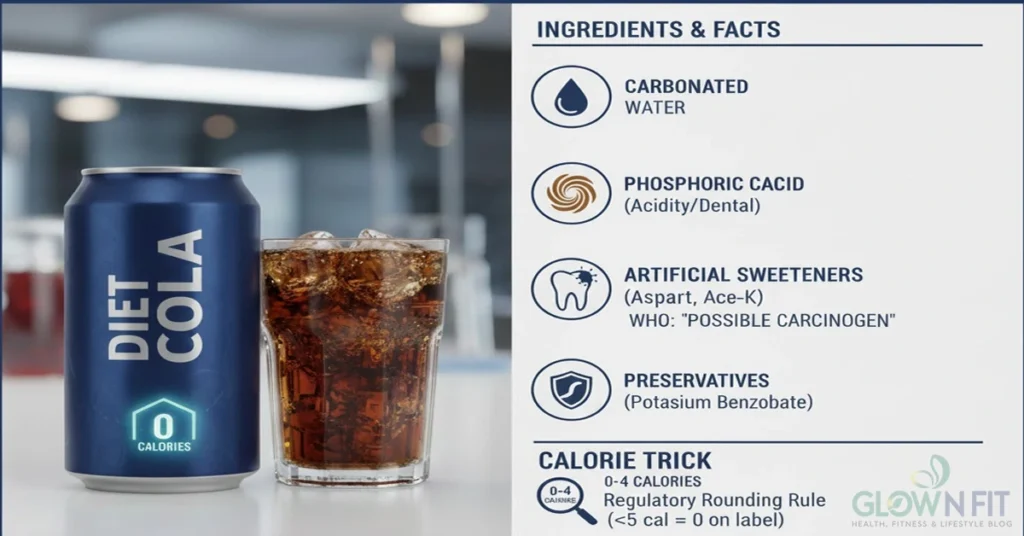
While recipes vary between brands, most diet colas share a common core of ingredients:
-
Carbonated water
-
Caramel color
-
Phosphoric acid (for tanginess)
-
Artificial sweeteners (e.g., aspartame, acesulfame-potassium)
-
Preservatives (like potassium benzoate)
-
Natural flavors
-
Caffeine
For example, Diet Coke lists its ingredients as carbonated water, aspartame, phosphoric acid, natural flavors, citric acid, potassium benzoate, and caffeine. Coca-Cola+1
It also contains roughly 46 mg of caffeine per 12 fl oz (355 ml) can. Coca-Cola
Diet Cola Nutrition Profile
Calories and Macronutrients
-
According to Coca-Cola’s own nutrition facts, a 12 oz (355 ml) can of Diet Coke has 0 calories. Coca-Cola
-
However, nutrition databases sometimes report tiny traces: for instance, a generic diet soda has ≈ 4 calories per 12 oz according to FatSecret.
-
These trace calories come from non-macronutrient sources (like minimal amino acids) and are so small that regulatory bodies allow them to be labeled as “0.” Living Well Clinical Nutrition Center
-
According to one nutrition site, a 12 oz can of Diet Coke has 0 g fat, 0 g carbohydrates, 0 g protein, and around 40 mg sodium. Fairway Market
Sweeteners & Additives
-
Aspartame: One of the most common artificial sweeteners. It’s about 200 times sweeter than sugar, which means only milligrams are needed. Living Well Clinical Nutrition Center+1
-
Acesulfame Potassium (Ace-K): Another zero-calorie sweetener used in some diet colas. Coca-Cola
-
Phosphoric Acid: Gives diet colas their tangy flavor and acts as a preservative.
-
Potassium Benzoate: Prevents microbial growth.
-
Citric Acid & Natural Flavors: For flavor complexity and balance.
Caffeine Content
-
As noted, a standard 12 oz Diet Coke can has about 46 mg of caffeine. Coca-Cola
-
For comparison, regular cola and other sodas may have different caffeine levels, but this is fairly typical for diet colas.
Why Diet Cola Can Be Labeled “Zero-Calorie” (H2)
Regulatory Rounding Rules
-
In many countries, including the U.S., if a food or drink has fewer than 5 calories per serving, manufacturers are allowed to round down to “0 calories” on the label. Living Well Clinical Nutrition Center
-
That’s why even if there are trace amounts of calories (from sweeteners like aspartame), they don’t show up on the nutrition panel.
How Aspartame Adds Tiny Calories
-
Aspartame is a compound made from amino acids (phenylalanine and aspartic acid). When broken down, these contribute a very small caloric value.
-
For example, a typical can may contain around 125 mg of aspartame, translating to only about 0.4–0.5 calories.
-
Because this is so minimal, it’s effectively “zero” for everyday consumption, but scientifically it’s not truly calorie-free.
Health Implications of Diet Cola Nutrition
Understanding diet cola nutrition involves considering both potential benefits and risks.
Potential Benefits
-
Weight Management
-
Swapping regular soda for diet cola can significantly cut calorie intake. For instance, a regular 12 oz soda has ~140–150 calories.
-
Over time, this reduction can support weight loss or maintenance if used in place of sugary beverages.
-
-
Sugar Control
-
Since diet cola has zero grams of sugar, it doesn’t spike blood sugar like regular soda. This makes it appealing for people managing diabetes or those on low-carb diets.
-
-
Hydration Alternative
-
For those who dislike plain water, diet cola can serve as an occasional fizzy alternative — though it shouldn’t fully replace healthier hydration options.
-
Potential Risks and Drawbacks
-
Artificial Sweetener Concerns
-
Aspartame: The World Health Organization (WHO) has classified aspartame as a “possible carcinogen” (Group 2B) under certain conditions.
-
Long-term effects: While within acceptable daily intake (ADI) levels, some people prefer to limit sweetener consumption.
-
-
Metabolic Effects
-
Some research suggests artificial sweeteners may alter gut bacteria or insulin response, although evidence is mixed.
-
More recently, a preprint study used causal inference methods and indicated that 20–50% of individuals (especially those with poor dietary habits) might be more likely to gain weight from regular Diet Coke consumption. arXiv
-
-
Dental Health
-
The acidity (from phosphoric acid) in diet cola can erode tooth enamel over time.
-
-
Sodium Intake
-
Although not very high, sodium is present (e.g., 40 mg per can in Diet Coke).
-
-
Caffeine-Related Issues
-
With ~46 mg per can, frequent consumption could contribute to excessive caffeine intake in sensitive individuals.
-
Comparing Diet Cola to Regular Cola
A side-by-side comparison helps underscore the differences in nutrition, health impact, and usage.
| Feature | Diet Cola | Regular Cola |
|---|---|---|
| Calories per 12 oz | 0 (or up to 4–5 trace) FatSecret+1 | ~140–150 calories Livestrong+1 |
| Sugar | 0 g | ~39–41 g (or more) Livestrong |
| Sweeteners | Artificial (aspartame, Ace-K) | Sugar / high-fructose corn syrup |
| Caffeine | ~46 mg per 12 oz (Diet Coke) Coca-Cola | Varies, but similar ranges in caffeinated sodas |
| Health Risks | Concerns around sweeteners, acidity, metabolic effects | High sugar can lead to obesity, diabetes, metabolic syndrome |
Real-World Insights & Statistics
-
According to a nutritional database, a 12 oz can of diet soda has around 4 calories per serving.
-
According to Coca-Cola’s site, Diet Coke’s sodium content is about 40 mg per 12 oz can.
-
A causal inference study (preprint) found that 20–50% of individuals may gain weight through Diet Coke consumption depending on their diet and lifestyle.
-
The WHO classifies aspartame as a “possible carcinogen.”
These data points give a balanced view: while diet colas do reduce calories drastically, they’re not risk-free.
Tips for Drinking Diet Cola Wisely
If you choose to include diet cola in your diet, here are practical tips to make it a safer, more mindful habit:
-
Moderation Is Key
-
Limit consumption to avoid excessive exposure to artificial sweeteners and acidity.
-
Use diet cola as an occasional treat rather than a daily staple.
-
-
Stay Hydrated with Water
-
Always complement with plain water or healthier drinks (e.g., sparkling water, herbal teas).
-
-
Check Labels
-
Look at caffeine, sodium, and sweetener type on the nutrition label.
-
Opt for caffeine-free versions if you’re sensitive to caffeine.
-
-
Balance with Your Diet
-
Make sure your overall diet includes plenty of whole, nutrient-rich foods. Diet cola does not provide any vitamins, fiber, or protein.
-
-
Dental Care
-
Rinse your mouth with water after drinking diet soda to minimize acid damage to teeth.
-
Consider using a straw to reduce contact with teeth.
-
Controversies & Ongoing Research
Aspartame Safety Debate
-
While regulatory bodies like the FDA consider aspartame safe within acceptable daily intake limits, some studies and agencies (like WHO) have raised concerns over long-term risks.
-
There is still debate in scientific literature about possible links to cancer, metabolic disorders, and gut health.
Impact on Weight & Metabolism
-
Contrary to popular belief that diet soda helps with weight loss, emerging causal inference research suggests a more nuanced picture.
-
Factors like diet quality, individual metabolism, and lifestyle play a big role: not everyone benefits equally from switching to “zero-calorie” sodas.
Gut Microbiome & Insulin Response
-
Some early research hints that artificial sweeteners may alter gut bacteria or affect insulin sensitivity, though more robust, long-term studies are needed.
Pros & Cons — A Quick Recap
Pros
-
Cuts down on sugar and calories
-
Helps with weight management (when used smartly)
-
Provides familiar soda taste
-
Zero sugar load — better for blood sugar control
Cons
-
Contains artificial sweeteners (possible long-term risks)
-
Acidic, which may affect dental health
-
No real nutritional value (no proteins, vitamins, or fiber)
-
Caffeine content can add up
Conclusion
Understanding diet cola nutrition means looking beyond the “zero-calorie” label. While diet colas deliver a sweet, fizzy experience without the sugar load of regular sodas, they are not harmless. They contain artificial sweeteners, acids, and caffeine — and though they contribute virtually no calories, moderate consumption is still important.
If you enjoy diet cola, use it as an occasional treat. Combine it with water intake, maintain a balanced diet, and stay alert to how it affects you personally. As research continues to evolve, keeping informed helps you make better choices — for your tastebuds and your health.
Curious to explore more about healthy drink alternatives or sugar-free swaps? Check out our blog on “Healthier Soda Alternatives” or “How to Reduce Sugar in Your Diet Without Sacrificing Flavor” — learn how you can make smart, sustainable choices for your daily hydration.